How to Get Paid as a Contractor in Argentina (2026 Guide): Maximize your USD and Navigate Regulations
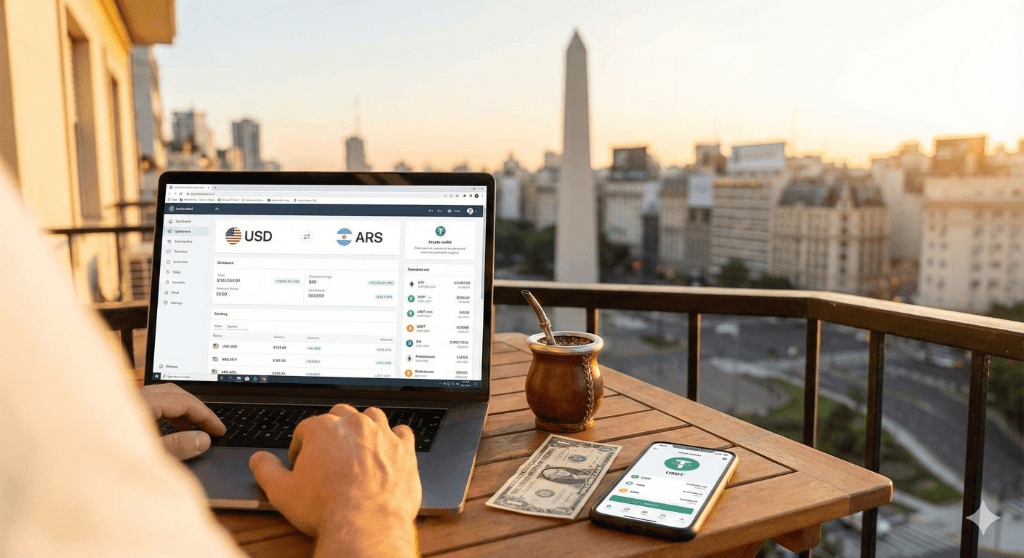
Argentina's economic landscape in 2026 remains a unique challenge: a frontier market with high volatility that functions as a global hub for knowledge-based services. For a contractor earning in dollars, the problem isn't just securing the job, but choosing the right financial "pipeline" to avoid losing purchasing power to the exchange gap, taxes, and new transparency standards like CRS 2.0.
Whether you're a junior developer earning $1,000 USD or a senior lead making $6,000 USD, your payment strategy will determine if you build a solid legal future or live under the radar with increasing risks.
THE 3 STRATEGIC PAYMENT SCENARIOS
1. THE LEGALIZATION ROUTE: EXPORT INVOICE (FACTURA E) + WISE
Thanks to Communication A8330, service exporters can receive dollars directly into Argentine bank accounts without the obligation to convert them to Pesos at the official rate.
- The Flow: Employer → Wise USD → Local USD Bank Account → Sale via MEP (Dólar Bolsa).
- Compliance: Full reporting via Export Invoice (Factura E) to ARCA (formerly AFIP).
- The Cost: Wise commissions (approx. 2.22%) plus the monthly fee for "Monotributo" or the "Responsable Inscripto" regime.
2. THE OPTIMIZATION ROUTE: BITWAGE/WALLBIT + USDT + CUEVA (EXCHANGE HOUSE)
This route prioritizes liquidity and maximizes the exchange rate by bypassing the traditional banking system.
- The Flow: Employer → Bitwage/Wallbit → Polygon Network (USDT) → Local "Cueva" (Cash).
- Compliance: Informal (gray market). Risk of "self-laundering" charges if expenses don't match declared income.
- The Cost: Bitwage/Wallbit fee (1%), conversion spread (~1.5%), and exchange house commission (3-5%).
3. THE "INVISIBLE EXPENSE" ROUTE: BITWAGE/WALLBIT + USDT + DIRECT PAYMENTS
A modern hybrid that uses crypto for daily consumption without touching banks or exchange houses.
- The Flow: Employer → Bitwage/Wallbit → Polygon (USDT) → Direct payment to merchants accepting USDT at the Official Dollar rate.
- Compliance: Informal, but traceable through Virtual Asset Service Providers (PSAV).
- The Cost: Platform fees and the "hidden cost" of spending at an official exchange rate instead of the Blue rate.
INCOME COMPARISON: 1,000 USD VS. 6,000 USD MONTHLY
INCOME LEVEL: 1,000 USD/month (~12,000 USD annually)
At this level, you comfortably fit into Monotributo Category C.
| Item | Formal (RI Taxpayer) | Optimization (Cueva) | Invisible Expense (USDT) |
|---|---|---|---|
| Gross (USD) | $1,000.00 | $1,000.00 | $1,000.00 |
| Commissions/Taxes | -$65.00 (Tax + Fees) | -$40.00 (Fees) | -$25.00 (Fees) |
| Net (ARS) | $1,402,598 | $1,449,977 | $1,448,097 |
| Efficiency | 94% | 96% | 97.5% |
Verdict: For a difference of only 2-3%, the legal route (Factura E) is the smartest for this level, as it builds credit history.
INCOME LEVEL: 6,000 USD/month (~72,000 USD annually)
Here you exceed the Monotributo cap and become a "Responsable Inscripto" (RI), which triggers Income Tax (up to 35%).
| Item | Formal (RI Taxpayer) | Optimization (Cueva) | Invisible Expense (USDT) |
|---|---|---|---|
| Gross (USD) | $6,000.00 | $6,000.00 | $6,000.00 |
| Commissions/Taxes | -$1,860.00 (Tax + Fees) | -$240.00 (Fees) | -$150.00 (Fees) |
| Net (ARS) | $6,139,606 | $8,700,318 | $8,688,586 |
| Efficiency | ~70% | 96.5% | 97.5% |
Verdict: The "RI Trap" is real. You lose over 2.5 million pesos per month in taxes. At this level, most professionals opt for US LLC structures to keep savings abroad and only "bring down" what's necessary via Monotributo.
CRITICAL RISKS IN 2026
- The End of the Crypto "Vault": With CRS 2.0 and the CARF framework, exchanges and intermediaries report virtual asset movements.
- ARCA Surveillance: The new agency uses data analytics to cross-reference spending (cards, travel) with declared income.
- Account Closures: Platforms like Wise and Deel are tightening compliance, closing accounts for "unjustifiable" transfers.
SPRINT'S FINAL RECOMMENDATION
- If you earn between 1k and 3k USD: Go formal. The benefit of being under A8330 outweighs the small savings from exchange houses.
- If you earn 5k USD or more: Use a US LLC in Wyoming or New Mexico. Keep the bulk of your wealth in Ireland-domiciled ETFs and declare a portion in Argentina as a Monotributista.
- The "Crypto-Hybrid" Route (USDT): Consider getting paid and keeping savings in USDT (via Bitwage/Wallbit). It gives you total flexibility to withdraw funds or spend directly.
APPENDIX: THE TAX EFFICIENCY MAP
AT WHAT POINT DOES LEGALITY BECOME "EXPENSIVE"?
There are specific "pain points" where the tax burden increases sharply due to Monotributo category jumps and the transition to the "Responsable Inscripto" (RI) regime.
| Monthly Income (USD) | Tax Regime (Est. 2026) | % Lost (Formal Route) | Main Reason for Loss |
|---|---|---|---|
| $1,000 | Monotributo Cat. C | ~6.5% | Wise commissions + Low fixed fee |
| $1,500 | Monotributo Cat. E | ~6.0% | Efficient scale; the fee is diluted |
| $2,000 | Monotributo Cat. F | ~6.1% | Maintained efficiency in middle scales |
| $2,500 | Monotributo Cat. H | ~11.0% | Jump: Cat. H fee is significantly higher |
| $3,000 | Monotributo Cat. H | ~10.5% | Fixed fee for the category stabilizes |
| $3,500 | Monotributo Cat. I | ~15.5% | Jump: Sharp increase in tax component |
| $4,000 | Monotributo Cat. I | ~14.5% | Efficiency ceiling in high categories |
| $4,500 | Monotributo Cat. K | ~18.0% | Jump: Last scale before general regime |
| $5,000 | Monotributo Cat. K | ~17.0% | Maximum use of simplified regime |
| $5,500 | Monotributo Cat. K | ~16.5% | Limit of the tax comfort zone |
| $6,000+ | Resp. Inscripto | \~32.0% | The Abyss: You start paying Income Tax (up to 35%) |